August 29 2025
The lab was recently awarded an NSF/Kavli Foundation award for Neurobiology in Changing Ecosystems. As a part of this work, Dr. Michael Tackenberg (Department of Biology) and I are recruiting a new graduate student. Here is a flyer describing this opportunity:
August 26 2025
The lab received funds to develop microsensors to measure worker jelly inside honey bee hives. Read about it here. This was funded by the Research Corporation for Science Advancement Scialog program.
Check out this article about our recently published study on weeds for bees!
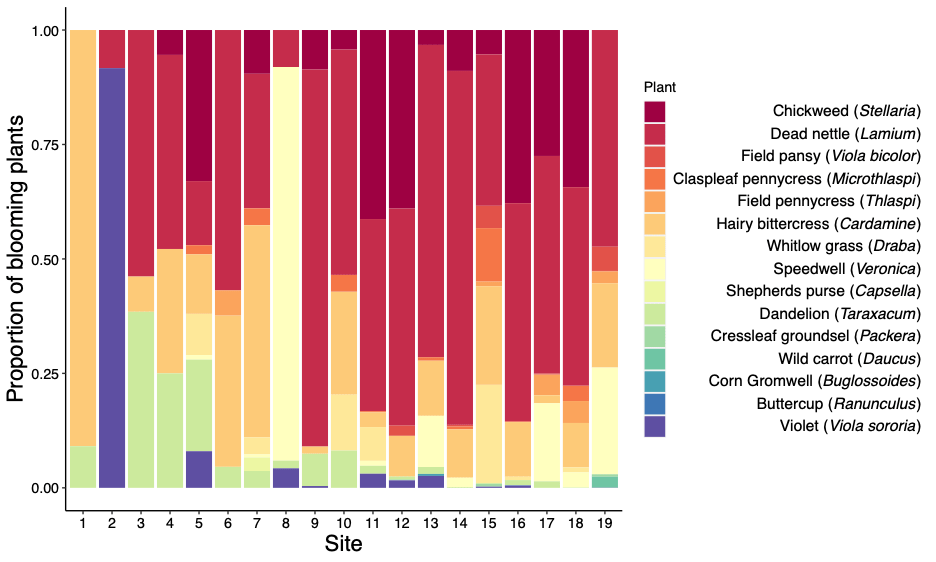
The article linked above describes the basic findings of our study that investigates how winter annual weeds on fallow croplands influence honey bee colony growth in the pre-swarm late-winter/early-spring. For interested beekeepers, here is a list of the various winter annual weed species we observed on sites with enhanced colony growth during the pre-swarm period:
| Name | Family |
| Chickweed (Stellaria media) | Caryophyllaceae |
| Butterweed (Packera glabella) | Asteraceae |
| Purple dead nettle (Lamium purpureum) | Lamiaceae |
| Henbit dead nettle (Lamium amplexicaule) | Lamiaceae |
| Clasp leaf pennycress (Microthlaspi peroliatum) | Brassicaceae |
| Dandelion (Taraxacum officinale) | Asteraceae |
| Hairy bittercress (Cardamine hirsuta) | Brassicaceae |
| Field pansy (Viola bicolor) | Violaceae |
| Field pennycress (Thlaspi arvense) | Brassicaceae |
| Whitlow grass (Draba verna) | Brassicaceae |
| Speedwell (Veronica spp.) | Plantaginaceae |
| Shepherds purse (Capsella bursa-pastoris) | Brassicaceae |
| Creeping Charlie (Glechoma hederacea) | Lamiaceae |
| Wild violet (Viola sororia) | Violaceae |
| Bird rape mustard (Brassica rapa) | Brassicaceae |
| Pepperweed (Lepidium spp.) | Brassicaceae |
| Yellow rocket (Barbarea vulgaris) | Brassicaceae |
| Corn gromwell (Buglossoides arvensis) | Boraginaceae |
| Wild carrot (Daucus carota) | Apiaceae |
| Buttercup (Ranunculus spp.) | Ranunculaceae |
| Daisy fleabane (Erigeron annuus) | Asteraceae |
| Spring beauty (Claytonia virginica) | Portulacaceae |
| Spurge (Euphobia spp.) | Euphorbiaceae |
Notably, sites were quite variable in the type and distribution of weedy species present. However, on sites where winter annual weeds were plentiful, three major species dominated – henbit dead nettle, purple dead nettle, and common chickweed.
Congratulations to Rebecca Westwick!
Rebecca successfully defended her PhD and started a postdoc at Indiana University! (Aug 2023)
Rebecca received the Marlene Zuk award for the best Animal Behavior student talk at the national Society for Integrative and Comparative Biology meeting in Austin, TX (Jan 2023).
Two lab members receive NSF GRFP
Congratulations to Wade Pike and Anastasia Weger, recipients of these prestigious graduate fellowships.
Lab receives NSF CAREER award to study the regulation of complex social behaviors

Life experiences change individual behavior through complex interactions between environmental inputs and gene activity in the brain; it is unclear why certain experiences have lasting effects on behavior while other effects are easily reversed. This question is relevant to animal biodiversity, but also human health research, where one goal is to mitigate the behavioral impacts of experiences like social trauma. Though dynamic brain gene activity underlies experience-induced changes in behavior, the exact mechanisms that regulate the persistence of an experience are unclear. For example, experience may chemically alter brain DNA and therefore permanently change gene activity. However, a change in gene activity itself may be temporary, but lead to permanent changes in other factors that influence behavior, like brain structure. This study uses experimental manipulations of gene regulating mechanisms to determine whether certain ones reliably predict the longevity of an experience. The subject of these studies is the honey bee (Apis mellifera), a critical crop pollinator with a well-established relationship between social experience, brain gene activity, and aggressive behavior. Teams composed of students and beekeepers will complete research objectives and organize a summit that introduces high school students to research results and academic, industry, and non-profit career opportunities in Agricultural STEM. In addition to filling critical knowledge gaps in the study of behavioral diversity, this project will improve public science literacy and enhance partnerships among students and professionals inside and outside of academia. These steps contribute to an overall outcome of increased STEM workforce diversity, retention and career success.
Congratulations Grayson Grume!
Grayson’s Master’s thesis manuscript was recently published in Animal Behaviour:
Grume, G.J., S.P. Biedenbender, and C.C. Rittschof, Honey robbing causes coordinated changes in foraging and nest defence in the honey bee, Apis mellifera. Animal Behaviour, 2021. 173: p. 53-65.
Congratulations to Rebecca Westwick!
Rebecca sailed through her qualifying exams and is now a PhD candidate!
Congratulations Hanna Carr!
Hanna’s undergraduate research manuscript “Honey bee aggression: evaluating causal links to disease-resistance traits and infection” was recently accepted for publication in Behavioral Ecology and Sociobiology! (Summer 2020)
Lab receives funds to use study the aggressive honey bee brain and links to neurodegeneration
With Dr. Patrick Sullivan (UK College of Medicine), the lab was awarded a University of Kentucky Neuroscience Research Priority Area grant to assess metabolic dynamics in the honey bee brain using metabolomics approaches.
Congratulations to Amanda Dunaway!
Amanda passed her qualifying exams (Summer 2020) with flying colors!
Congratulations to Rebecca Westwick!
Rebecca received a Sigma Xi Grant-in-Aid of Research Award for her work on social interactions and health response.
Congratulations to Grayson Grume!
Grayson successfully completed his M.S. degree (Spring 2020) and has taken a position with the Florida State Parks Service.
Lab receives funds to study honey bee viruses in Kentucky (spring 2020)

The lab received 2 years of support from the Kentucky Agriculture Development Fund to develop methods for Kentucky honey bee virus testing, and to study the impacts of nutrition on viral presence and abundance. Caroline Kane will work on this project for her M.S. degree.
Congratulations to Taylor Napier and Anna Foose!
Taylor and Anna received competitive summer research fellowships from the UK Office of Undergraduate Research (Summer 2020). Both are working on honey bee behavior, health, and aggression.
Congratulations to Jimmy Harrison!

We are pleased to welcome Jimmy back to the lab as our new research technician. Jimmy was a neuroscience major in the lab. His work as an undergraduate was recently accepted for publication in Scientific Reports!
Congratulations to Rebecca Westwick – Recipient of ABS Student Research Grant!
Rebecca was awarded a 1-year grant from the Animal Behavior Society for her work on the interactions between alarm pheromone and begging pheromones. Rebecca is exploring whether this interaction explains why early-life social environment affects adult aggression in honey bees.
Congratulations to Amanda Dunaway – 3rd place winner at OVEA!
Amanda Dunaway (PhD Student) won third place at the Ohio Valley Entomological Society meetings for her presentation on the impacts of surface mining on wild bee communities in Eastern Kentucky. Amanda completed this work as part of her Master’s Degree with Valerie Peters at Eastern Kentucky University.
Congratulations to Sarah Preston for successfully defending her Masters Degree!

Sarah’s work was awarded first place in the President’s Prize poster competition at the 2017 Entomological Society of America national meeting in Denver, CO. She also received third place for her poster at the 2018 ESA North Central Branch meeting (Madison, WI). Both awards were for Sarah’s work on maternal stress effects on worker bee behavior and immune function in the honey bee.
Foundation for Food and Agriculture Research Grant Awarded

We were awarded a 3-year grant to study the impacts of winter annual weeds on wild bee communities and honey bee health in the context of agricultural lands. This is collaborative work with Erin Haramoto in Plant and Soil Sciences (UK) and Sandra Rehan (UNH). Read more about this project here:
https://www.morningagclips.com/uk-researchers-to-study-pollinator-food-availability/
Congratulations to Clare Rittschof!
I am deeply honored to receive the 2018 Outstanding New Investigator award from the Animal Behavior Society.
 The Rittschof Lab